Technological Progress and Potential Future Risks
- Get link
- X
- Other Apps
The list of new technologies grows every day. Robots, Augmented Reality, algorithms, and machine-to-machine communications help people with a range of different tasks.(1) These technologies are broad-based in their scope and significant in their ability to transform existing businesses and personal lives. They have the potential to ease people’s lives and improve their personal and business dealings.(2) Technology is becoming much more sophisticated and this is having a substantial impact on the workforce.(3)
In this paper, I explore the impact of robots, artificial intelligence, and machine learning on the workforce and public policy. If society needs fewer workers due to automation and robotics, and many social benefits are delivered through jobs, how are people outside the workforce for a lengthy period of time going to get health care and pensions? These are profound questions for public policy and we need to figure out how to deliver social benefits in the new digital economy.
EMERGING TECHNOLOGIES
Robots
Industrial robots are expanding in magnitude around the developed world. In 2013, for example, there were an estimated 1.2 million robots in use. This total rose to around 1.5 million in 2014 and is projected to increase to about 1.9 million in 2017.(4) Japan has the largest number with 306,700, followed by North America (237,400), China (182,300), South Korea (175,600), and Germany (175,200). Overall, robotics is expected to rise from a $15-billion sector now to $67 billion by 2025.(5)
According to an RBC Global Asset Management study, the costs of robots and automation have fallen substantially. It used to be that the “high costs of industrial robots restricted their use to few high-wage industries like the auto industry. However, in recent years, the average costs of robots have fallen, and in a number of key industries in Asia, the cost of robots and the unit costs of low-wage labor are converging… Robots now represent a viable alternative to labor.”(6)
In the contemporary world, there are many robots that perform complex functions. According to a presentation on robots:
The early 21st century saw the first wave of companionable social robots. They were small cute pets like AIBO, Pleo, and Paro. As robotics become more sophisticated, thanks largely to the smart phone, a new wave of social robots has started, with humanoids Pepper and Jimmy and the mirror-like Jibo, as well as Geppetto Avatars’ software robot, Sophie. A key factor in a robot’s ability to be social is their ability to correctly understand and respond to people’s speech and the underlying context or emotion.(7)
These machines are capable of creative actions. Anthropologist Eitan Wilf of Hebrew University of Jerusalem says that sociable robots represent “a cultural resource for negotiating problems of intentionality.”(8) He describes a “jazz-improvising humanoid robot marimba player” that can interpret music context and respond creatively to improvisations on the part of other performers. Designers can put it with a jazz band, and the robot will ad lib seamlessly with the rest of the group. If someone were listening to the music, that person could not discern the human from the robot performer.
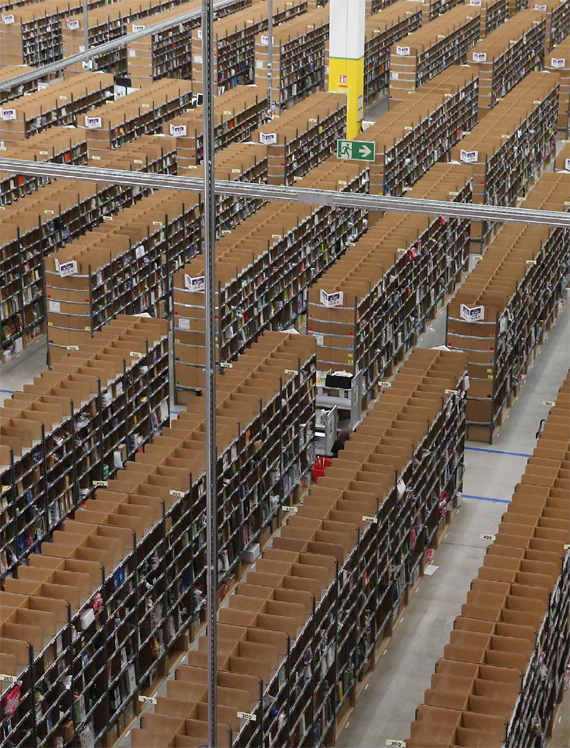
Amazon has organized a “picking challenge” designed to see if robots can “autonomously grab items from a shelf and place them in a tub.” The firm has around 50,000 people working in its warehouses and it wants to see if robots can perform the tasks of selecting items and moving them around the warehouse. During the competition, a Berlin robot successfully completed ten of the twelve tasks. To move goods around the facility, the company already uses 15,000 robots and it expects to purchase additional ones in the future.(9)
In the restaurant industry, firms are using technology to remove humans from parts of food delivery. Some places, for example, are using tablets that allow customers to order directly from the kitchen with no requirement of talking to a waiter or waitress. Others enable people to pay directly, obviating the need for cashiers. Still others tell chefs how much of an ingredient to add to a dish, which cuts down on food expenses.(10) Other experimentalists are using a robot known as Nao to help people deal with stress. In a pilot project called “Stress Game,” Thi-Hai-Ha Dang and Adriana Tapus subject people to a board game where they have to collect as many hand objects as they can. During the test, stress is altered through game difficulty and noises when errors are made. The individuals are wired to a heart monitor so that Nao can help people deal with stress. When the robot feels human stress levels increasing, it provides coaching designed to decrease the tension. Depending on the situation, it can respond in empathetic, encouraging, or challenging ways. In this way, the “robot with personality” is able to provide dynamic feedback to the experimental subjects and help them deal with tense activities.(11)
Computerized Algorithms
There are computerized algorithms that have taken the place of human transactions. We see this in the stock exchanges, where high-frequency trading by machines has replaced human decision making. People submit buy and sell orders, and computers match them in the blink of an eye without human intervention. Machines can spot trading inefficiencies or market differentials at a very small scale and execute trades that make money for people.(12)
Some individuals specialize in arbitrage trading, whereby the algorithms see the same stocks having different market values. Humans are not very efficient at spotting price differentials but computers can use complex mathematical formulas to determine where there are trading opportunities. Fortunes have been made by mathematicians who excel in this type of analysis.(13)
Artificial Intelligence
Artificial intelligence refers to “machines that respond to stimulation consistent with traditional responses from humans, given the human capacity for contemplation, judgment and intention.”(14) It incorporates critical reasoning and judgment into response decisions. Long considered a visionary advance, AI is now here and being incorporated in a variety of different areas. It is being used in finance, transportation, aviation, and telecommunications. Expert systems “make decisions which normally require a human level of expertise.”(15) These systems help humans anticipate problems or deal with difficulties as they come up.
There is growing applicability of artificial intelligence in many industries.(16) It is being used to take the place of humans in a variety of areas. For example, it is being used in space exploration, advanced manufacturing, transportation, energy development, and health care. By tapping into the extraordinary processing power of computers, humans can supplement their own skills and improve productivity through artificial intelligence.
IMPACT ON THE WORKFORCE
The rapid increase in emerging technologies suggests that they are having a substantial impact on the workforce. Many of the large tech firms have achieved broad economic scale without a large number of employees. For example, Derek Thompson writes: “Google is worth $370 billion but has only about 55,000 employees—less than a tenth the size of AT&T’s workforce in its heyday [in the 1960s].”(17) According to economist Andrew McAfee: “We are facing a time when machines will replace people for most of the jobs in the current economy, and I believe it will come not in the crazy distant future.”(18)
In a number of fields, technology is substituting for labor, and this has dramatic consequences for middle-class jobs and incomes. Cornell University engineer Hod Lipson argues that “for a long time the common understanding was that technology was destroying jobs but also creating new and better ones. Now the evidence is that technology is destroying jobs and indeed creating new and better ones but also fewer ones.”(19)
Martin Ford issues an equally strong warning. In his book, The Lights in the Tunnel, he argues that “as technology accelerates, machine automation may ultimately penetrate the economy to the extent that wages no longer provide the bulk of consumers with adequate discretionary income and confidence in the future. If this issue is not addressed, the result will be a downward economic spiral.”(20) Continuing, he warns that “at some point in the future—it might be many years or decades from now—machines will be able to do the jobs of a large percentage of the ‘average’ people in our population, and these people will not be able to find new jobs.”
Firms have discovered that robotics, machine learning, and artificial intelligence can replace humans and improve accuracy, productivity, and efficiency of operations. During the Great Recession of 2008–09, many businesses were forced to downsize their workforce for budgetary reasons. They had to find ways to maintain operations through leaner workforces. One business leader I know had five hundred workers for his $100 million business and now has the same size workforce even though the company has grown to $250 million in revenues. He did this by automating certain functions and using robots and advanced manufacturing techniques to operate the firm.
The US Bureau of Labor Statistics (BLS) compiles future employment projections. In its most recent analysis, the agency predicts that 15.6 million new positions will be created between 2012 and 2022. This amounts to growth of about 0.5 percent per year in the labor force.
The health-care and social assistance sector is expected to grow the most with an annual rate of 2.6 percent. This will add around five million new jobs over that decade. That is about one-third of all the new jobs expected to be created.(21) Other areas that are likely to experience growth include professional services (3.5 million), construction (1.6 million), leisure and hospitality (1.3 million), state and local government (929,000), finance (751,000), and education (675,000).
Interestingly, in light of technology advances, the information sector is one of the areas expected to shrink in jobs. BLS projections anticipate that about 65,000 jobs will be lost there over the coming decade. Even though technology is revolutionizing many businesses, it is doing this by transforming operations, not increasing the number of jobs. Technology can boost productivity and improve efficiency, but does so by reducing the number of employees needed to generate the same or even higher levels of production.
Manufacturing is another area thought to lose jobs. The BLS expects the United States to lose 550,000 jobs, while the federal government will shed 407,000 positions, and agriculture, forestry, fishing, and hunting will drop 223,000 jobs.(22) These sectors are the ones thought to be least likely to generate new positions in the coming decade.
Since BLS projections make few assumptions about emerging technologies, it is likely that their numbers underestimate the disruptive impact of these developments. It is hard to quantify the way that robots, artificial intelligence, and sensors will affect the workforce because we are in the early stages of the technology revolution. It is hard to be definitive about emerging trends because it is not clear how new technologies will affect various jobs.
But there are estimates of the likely impact of computerization on many occupations. Oxford University researchers Carl Frey and Michael Osborn claim that technology will transform many sectors of life. They studied 702 occupational groupings and found that “forty-seven percent of US workers have a high probability of seeing their jobs automated over the next twenty years.”(23) According to their analysis, telemarketers, title examiners, hand sewers, mathematical technicians, insurance underwriters, watch repairers, cargo agents, tax preparers, photographic process workers, new accounts clerks, library technicians, and data entry keyers have a ninety-nine percent of having their jobs computerized. At the other end of the spectrum, recreational therapists, mechanic supervisors, emergency management directors, mental health social workers, audiologists, occupational therapists, health-care social workers, oral surgeons, supervisors of fire fighters, and dieticians have less than a one percent chance of having their tasks computerized. They base their analysis of improving levels of computerization, wage levels, and education required in different fields.(24) In addition, we know that fields such as health care and education have been slow to embrace the technology revolution, but are starting to embrace new models. Innovations in personalized learning and mobile health mean that many schools and hospitals are shifting from traditional to computerized service delivery. Educators are using massive, open, online courses (MOOCs) and tablet-based instruction, while health-care providers are relying on medical sensors, electronic medical records, and machine learning to diagnose and evaluate health treatments.
Hospitals used to be staffed with people who personally delivered the bulk of medical treatment. But health providers now are storing information in electronic medical records and data-sharing networks are connecting lab tests, clinical data, and administration information in order to promote greater efficiency. Patients surf the web for medical information and supplement professional advice with online resources. Both education and health-care sectors are seeing the disruption that previously has transformed other fields.
- Get link
- X
- Other Apps
Comments
Post a Comment